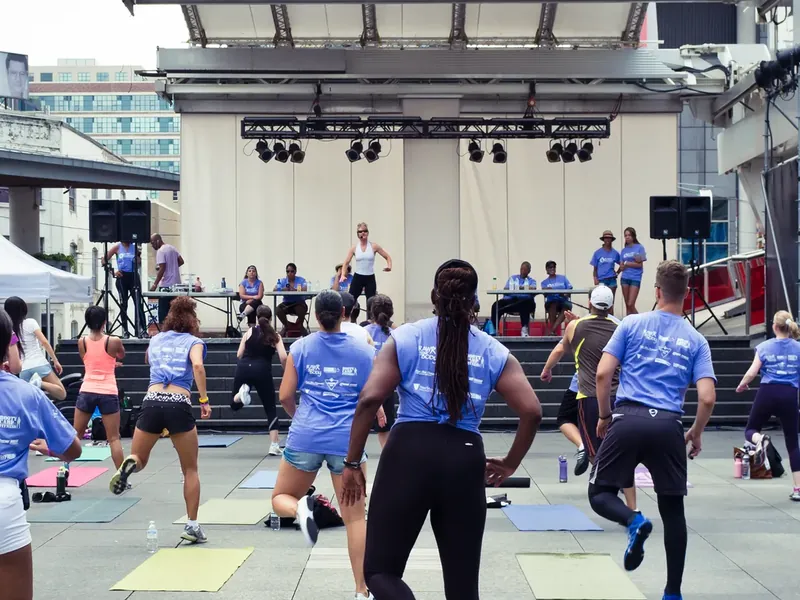
What a first session should feel like
Hard enough that you would rather not talk, easy enough that you could. The CDC's talk test puts it plainly: "A person doing moderate-intensity aerobic activity can talk, but not sing, during the activity," while someone at vigorous intensity "cannot say more than a few words without pausing for a breath." A first bootcamp session belongs at the top of the moderate band and dipping into the vigorous one during work intervals, not parked in the vigorous band from the first minute.
In heart-rate terms the American College of Sports Medicine puts moderate intensity at roughly 64 to 76% of maximum heart rate and vigorous at 77 to 95%. You do not need a monitor to use that. The talk test tracks it closely enough for a first month, and it works while you are upside down in a mountain climber, which a wrist reading often does not.
The mistake almost every beginner makes is treating session one as a test. It is not. The 20-minute beginner circuit is designed to be finished, and finishing it three times in week one teaches your body more than emptying the tank once and skipping the next two sessions.
Week one: finish it, do not beat it
Run the circuit as written. Six moves, 30 seconds of work, 15 seconds of rest, three rounds, 90 seconds between rounds. Start every move on its regression if there is any doubt: knee push-ups, chair-assisted squats, plank on the knees. Starting easier than necessary costs you nothing, because week two is four days away.
Two things matter in week one and nothing else does. The first is that all three sessions happen. The second is that your form holds for the full 30 seconds of each interval. If the last 10 seconds of push-ups turn into a sagging hip, the useful part of that interval ended at 20 seconds and the rest was practice at doing it wrong. The form mistakes guide covers the dominant fault in each of the six moves.
Expect soreness a day or two after the first session. Delayed onset muscle soreness after an unfamiliar session is normal and it fades as the same session repeats. It is a sign the work was new, not a measure of how well it worked.
The four-week progression
Progressive overload is the only mechanism that turns a repeated workout into fitness: you increase the demand once the current demand stops being demanding. For a beginner, the demand goes up in one variable at a time, and the circuit itself stays the same.
Four weeks of that is twelve sessions and a session that is roughly 40% longer at the end than at the start, without a single new exercise. If a week feels too hard to repeat, repeat the previous week instead of pushing on. The schedule is a default, not a deadline.
Notice what does not change: the six moves. Changing exercises every week feels productive and hides your progress, because you never repeat a session often enough to notice it getting easier. Keep the circuit and change one number at a time. When you do want to build a different circuit, the circuit-building guide and the circuit builder handle the movement-pattern slots for you.
Which regression to start from, move by move
A regression is not a lesser version of the exercise. It is the same movement pattern at a load you can control, and controlling the pattern is the point.
Drop one regression per week at most. Two at once turns a manageable session into a hard one and you lose the ability to tell which change caused it.
How often, and what the days off are for
Three sessions a week, with at least one day between them. The adaptation happens during recovery rather than during the circuit, which is why four hard sessions crammed into five days produces less than three spaced ones. The frequency and recovery guide goes through the overreaching signs worth watching for.
Three 20-minute sessions is 60 minutes a week. The CDC recommends adults get 150 minutes of moderate-intensity activity a week, or 75 minutes of vigorous, plus muscle-strengthening work covering all major muscle groups on 2 or more days. The circuit covers the muscle-strengthening half outright, because squats, push-ups, lunges, and planks in one round span legs, chest, back, and core. The aerobic half needs walking or cycling on the days between, which is the least demanding homework in fitness.
Three things that end a beginner's first month
Skipping the warm-up is first. Five minutes of marching, arm circles, easy squats and light jogging is not a formality, it raises heart rate and moves the joints through range before you ask them to do it fast. The warm-up guide has the sequence move by move.
Chasing soreness is second. Soreness is a response to novelty, so the only way to keep producing it is to keep changing the workout, which is exactly what stops you from progressing. By week three the session should feel easier at the same numbers, and that is the signal to raise one of them.
Starting at four or five sessions a week is third, and it is the most common. It works for about ten days. Then a missed session becomes two, and the whole thing quietly stops. Three sessions you actually complete beat five you plan.
When you stop being a beginner
When four rounds at 30 seconds on and 60 seconds between rounds feels repeatable rather than survivable, and every move is running without a regression. That usually lands somewhere between week four and week eight, and there is no prize for arriving early.
From there the next step is intensity rather than length. Shorter work intervals at higher effort, which is what the HIIT bootcamp session does at 20 seconds on and 10 off, or added load and denser formats, which the advanced progressions guide covers. If you train at home with no equipment at all, the at-home bootcamp workout runs the same structure on a patch of floor.
Frequently asked
How long should a beginner bootcamp workout be?
About 20 minutes including the warm-up and cooldown. That is roughly 16 minutes of circuit at three rounds of six 30-second stations. Longer sessions are not better for a first month, because the limiting factor is how reliably you repeat the session, not how much you do in one sitting.
What bootcamp exercises should a beginner start with?
Six that cover the main movement patterns and need no equipment: bodyweight squats, push-ups, reverse lunges, a plank hold, glute bridges, and marching in place as active recovery. Each has a regression, so the same six work whether it is your first session or your fiftieth.
How many times a week should a beginner do bootcamp?
Three, with at least one day between sessions. Recovery is when the adaptation happens, so more frequent sessions in the first month usually produce less progress and a higher chance of quitting.
Can you do a bootcamp workout at home as a beginner?
Yes. The beginner circuit needs a patch of floor roughly the size of a yoga mat and nothing else. Swap jumping moves for low-impact versions if you have neighbours below, which the at-home guide covers.