Six formats at a glance
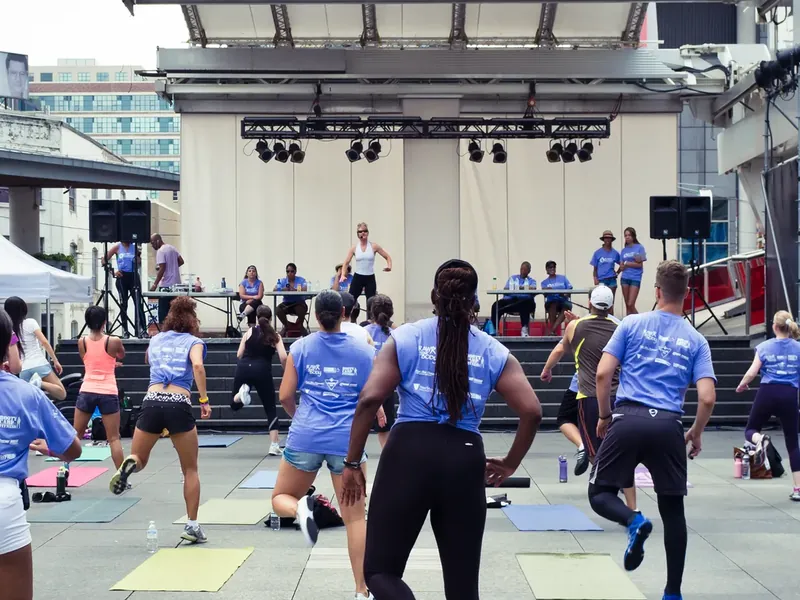
For a bodyweight bootcamp, pick a format and fill it with the basic moves: a ladder, a pyramid, a deck of cards, partner pairs, a chipper or a team relay. All six work for one person in a living room or twenty people on a field, and each takes 15 to 30 minutes after the 5-minute warm-up. The moves come from the exercise list, where each one has an easier and a harder version.
| Format | How it runs | Reps per move | Time cap |
|---|---|---|---|
| Ladder | 1 rep of each move, then 2, then 3, up to 10 | 55 | 15 min |
| Pyramid | 2, 4, 6, 8, 10, then back down to 2 | 50 | 20 min |
| Deck of cards | Suit picks the move, card value sets the reps | 95 for a full deck | 30 min |
| Partner pairs | One partner does reps, the other holds a position, then swap | 8 to 10 a set | 20 min |
| Chipper | One long list, done once, top to bottom | 10 to 50 | 25 min |
| Team relay | Run to a line, do the reps, run back, tag the next runner | 5 a turn | 15 min |
The time caps are there so a session ends on schedule. Hit the cap and you write down how far you got, which gives you a number to beat when the format comes round again.
Ladder
Take two moves that load different ends of the body, squats and push-ups for example. Do 1 squat and 1 push-up, then 2 and 2, then 3 and 3, and keep climbing to 10. That adds up to 55 reps of each. Rest between rungs only as long as you need to. The early rungs are easy and work as a second warm-up. The last three rungs hold almost half of the work, 27 of the 55 reps.
If push-ups fall apart before rung 10, switch to an incline push-up on a bench or wall for the rest of the ladder and keep counting. Fitter people can run the ladder to 15 (120 reps each) or swap squats for split squats, counting each leg.
Pyramid
Three moves, reps climbing 2, 4, 6, 8, 10 and coming back down 8, 6, 4, 2. Reverse lunges (each leg counts as one), sit-ups and burpees make a good set: legs, trunk, then the move that drives the heart rate. Each move totals 50 reps.
Fifty burpees is a lot for a newcomer. Halve the pyramid (1, 2, 3, 4, 5, 4, 3, 2, 1, so 25 reps a move) or use the step-back burpee with no jump. The way down is where pacing shows: if the second set of 8 takes much longer than the first, the climb was too fast.
Deck of cards
Shuffle a deck and give each suit a move: hearts squats, diamonds push-ups, clubs sit-ups, spades burpees. Turn a card and do the number on it. Jacks, queens and kings count 10 and aces count 11, so each suit holds 95 reps and the full deck 380. A joker, if you leave them in, is a one-minute plank.
A full deck is a long session, so most groups deal half the deck, or stop at the 30-minute cap and count the cards that are left. With a group, one person turns the cards and everyone does the same move, each at the version that suits them. Nobody knows which card comes next, so nobody can pace for a known finish.
Partner pairs
Partner A does a set while partner B holds a position. When A finishes, they swap. Run the four pairings below three times through:
The format suits pairs of different fitness. The slower partner sets the pace of the set, and the fitter partner's hold simply lasts longer, so both work for the whole session without one waiting on the other. Twelve sets each, with the swaps, fits inside the 20-minute cap.
Chipper
One list, done once, in order: 50 squats, 40 reverse lunges (20 each leg), 30 sit-ups, 20 push-ups, 10 burpees. That is 150 reps. Break each number up however you like, but finish a move before starting the next. Record the time, or the move you reached at the 25-minute cap.
A beginner version halves every number to 25, 20, 15, 10 and 5. Because the list never changes, the chipper is the best of the six for checking progress: run it again four weeks later and compare the times.
Team relay
Mark two lines 15 to 20 metres apart on grass or a hall floor and split the group into teams of three or four. The first runner runs to the far line, does 5 burpees, runs back and tags the next. Change the move every three minutes (squat jumps, then push-ups, then mountain climbers) and stop at 15 minutes.
In a team of three, each runner rests for about two turns for every turn they work. In teams of five or more people stand around too long between turns, so split them. The outdoor program covers the ground and heat checks for running this outside.
Keeping bodyweight hard enough
The CDC lists exercises that use your body weight, such as push-ups and sit-ups, as muscle-strengthening activity. It also says how hard: do each one "to the point where it's hard to do another repetition without help," aiming for 8 to 12 repetitions a set, on at least 2 days a week, covering the legs, hips, back, abdomen, chest, shoulders and arms. Someone who can do 30 relaxed squats in a row gets endurance work from squats and little strength work. The fix is a harder version of the same move.
| Pattern | Easier | Standard | Harder |
|---|---|---|---|
| Squat | Squat to a chair | Bodyweight squat | Split squat, then rear foot on a bench |
| Push | Incline push-up on a bench | Floor push-up | Feet on a bench, slow 3-second lowering |
| Hinge | Glute bridge | Single-leg glute bridge | Single-leg bridge with shoulders on a bench |
| Core | Plank on knees | Plank | Plank with alternating arm reach |
Progressing through push-up variations does build strength. Kotarsky and colleagues trained 23 moderately trained men three days a week for four weeks, one group on progressive push-up variations and one on the bench press, and both groups significantly increased their bench press one-rep max.
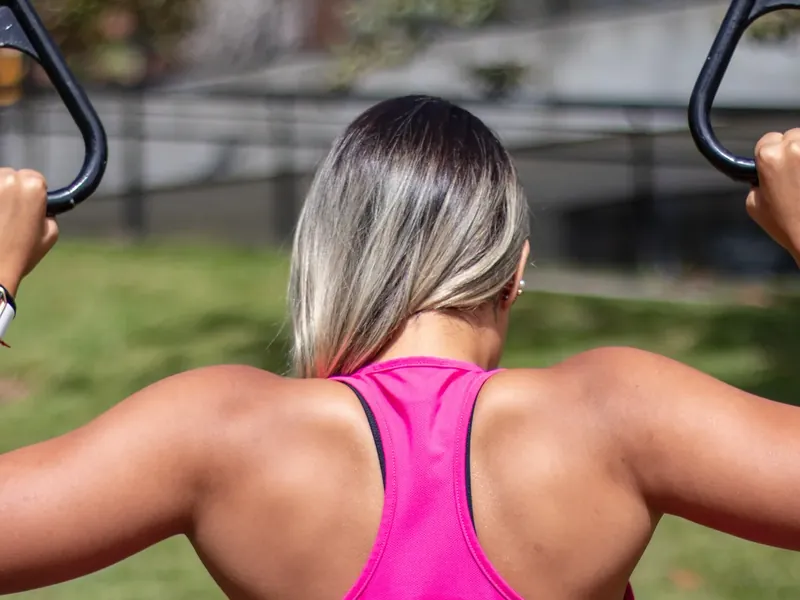
The back is the gap in a floor-only session. None of the six formats has a pulling move, and the CDC list includes the back. Prone Y raises (lying face down, lifting straight arms in a Y) train the upper back without kit. For a real pull you need something to hang from or pull against: park bars on the outdoor circuit, or a resistance band from the equipment guide.
Putting them into a week
Three sessions a week with a day between suits most people, which the recovery guide explains. Two of those three meet the CDC's 2 days of muscle-strengthening if the moves are hard enough. A week might run the chipper on Monday, partner pairs or the deck on Wednesday and a ladder on Friday. Keep the chipper and the ladder unchanged for three or four weeks so the times mean something. If you would rather have a timed circuit, the beginner program is one written out in full, and the circuit builder makes a new one from your minutes and level.
Frequently asked
What can you do in a bootcamp with no equipment?
Change the format and keep the moves. A ladder, a pyramid, a deck of cards, partner pairs, a chipper and a team relay all run on squats, lunges, push-ups, sit-ups, planks and burpees, and need nothing but floor space.
How long should a bodyweight bootcamp session be?
About 20 to 35 minutes, counting a 5-minute warm-up. Each format here has a time cap between 15 and 30 minutes. If you hit the cap, write down how far you got and try to beat it next time.
Can a bodyweight bootcamp build strength?
Yes, as long as the version of each move is hard enough. The CDC counts push-ups and sit-ups as muscle-strengthening and asks for 8 to 12 repetitions to the point where another is hard to do without help. If you can do 30 easy reps, move to a harder variation.
How do you run a bodyweight bootcamp for a group with mixed fitness?
Pick formats where everyone works to their own count. In partner pairs the fitter partner simply holds the isometric longer, and in a deck of cards each person picks the easier or harder version of the move on the card. Agree on both versions of every move before the first card is turned.