Start here: nothing
Every exercise in the beginner, HIIT, and outdoor programs uses bodyweight or, at most, a bench. Buying equipment before bodyweight versions of squats, push-ups, and lunges feel manageable is spending money to solve a problem you don't have yet.
First additions, once bodyweight gets easy
- Jump rope. Cheap, portable, and it adds a genuinely different cardio stimulus to a circuit without needing floor space beyond the rope's swing radius.
- A single resistance band. Adds load to push-ups, squats, and rows without the cost or storage problem of plates. Useful for both extra resistance and for assisting moves like pull-ups.
- One kettlebell. A single moderate-weight kettlebell covers swings, goblet squats, and presses, three moves that cover most of what a circuit needs from an added-weight tool.
For an experienced lifter building a home circuit setup
- A second, heavier kettlebell or a pair of dumbbells. Once single-kettlebell moves stop being challenging, having a heavier option, or a matched pair for two-handed moves, is the next real progression.
- A weighted vest. Adds load to every bodyweight move at once without changing the exercise pattern, which is the fastest way to keep bodyweight-style training challenging without switching to a barbell program.
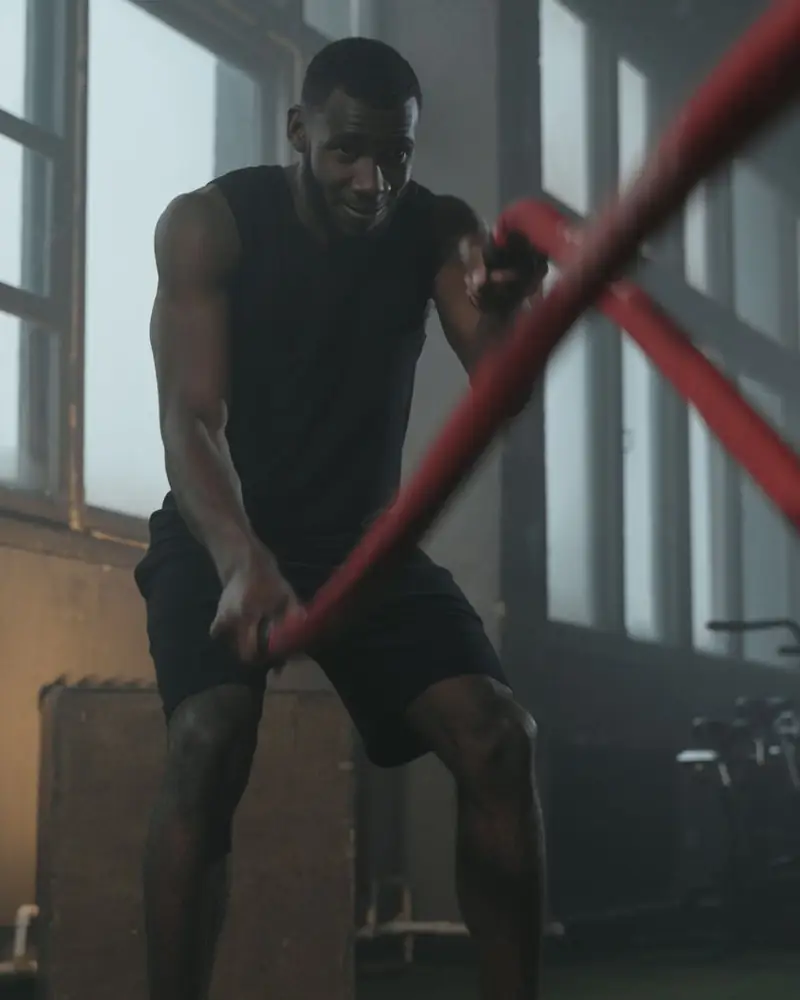
- Battle ropes. Genuinely upper-body and core intensive in a way few other tools replicate, worth it specifically if a circuit is missing an upper-body cardio station.
- Agility cones. Only worth it for outdoor group sessions or if a circuit specifically needs lateral movement and change-of-direction drills; skip it for a solo indoor setup. What else holds up outdoors is in the outdoor equipment guide.
Real numbers: kettlebell sizes and band tension
Kettlebells aren't sold in arbitrary weights. Competition kettlebells run in 4 kg increments, 8, 12, 16, 20, 24, 28, and 32 kg, each weight molded to a fixed size and color (pink at 8 kg through red at 32 kg) so the bell's dimensions stay the same as you go up and only the weight changes. A single moderate bell for most adults starting out falls in the 12 to 16 kg range for swings and goblet squats; the "second, heavier kettlebell" progression mentioned above usually means one or two increments up, to 20 or 24 kg, not doubling the weight.
Resistance bands aren't interchangeable by color across brands, but manufacturer spec sheets exist. TheraBand's published force chart, measured at 100% elongation (the band stretched to double its resting length), rates its color line at: Tan 2.4 lb, Yellow 3.0 lb, Red 3.7 lb, Green 4.6 lb, Blue 5.8 lb, Black 7.3 lb, Silver 10.2 lb, Gold 14.2 lb. A "medium" band for adding resistance to push-ups or rows is typically in the Blue-to-Black range, roughly 6 to 10 lb of added resistance at that stretch, but the color name alone doesn't tell you the tension without checking the specific brand's chart.
Frequently asked
What's the single best first purchase?
A resistance band, if budget is the constraint, a single kettlebell if it isn't. Both add load to moves you're already doing rather than requiring new exercises.
Do I need a full home gym for bootcamp-style training?
No. The format's entire appeal is that it doesn't require one. Even the advanced additions above fit in a closet, unlike a barbell rack and plates.