How a station rotation works
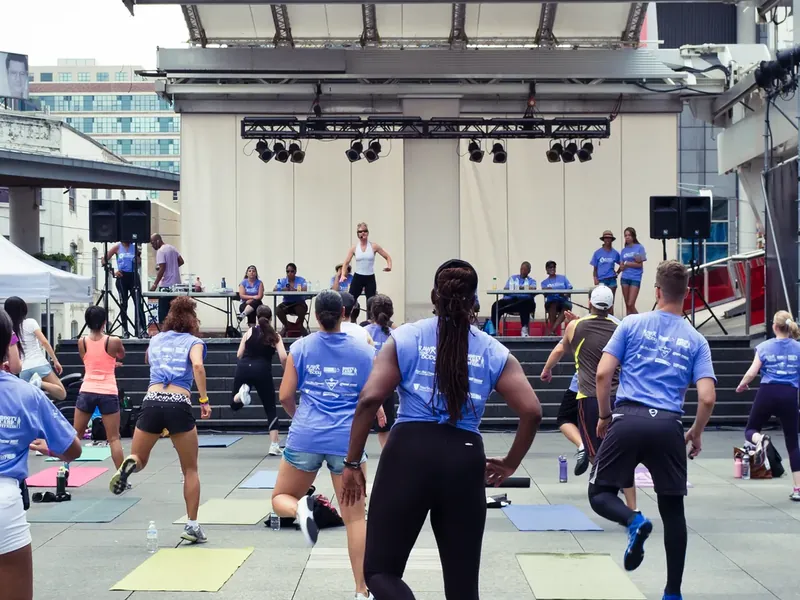
A station class puts one exercise at each spot in the room and moves the people instead of the equipment. Everyone starts at a different number, works for a set time, then walks to the next number on the signal. When each person has been to every station, that is one lap. For a mixed group, 40 to 45 seconds of work and 15 to 20 seconds to move suits almost any station on this page. Fifteen seconds is enough to walk a few steps and pick up a kettlebell. A station where a band has to be re-anchored or a weight swapped needs 20.
A lap takes stations × (work + transition). Eight stations at 45/15 is an 8-minute lap, so three laps with a minute of water between them come to 26 minutes. The 45-minute class plans put a warm-up, that circuit, a finisher and a cooldown on one clock; this page is the catalogue those plans draw their stations from. The formula for other work:rest ratios is in build your own circuit.
One thing a rotation cannot do is put the most technical move first, while everyone is fresh, the way a solo circuit does. Somebody always reaches the kettlebell swing as their eighth station. So every technical station below has a safe easier version written for the card, and the layouts keep those stations away from the spot right after the hardest cardio.
Legs: squat, single leg and hinge
Three slots, three stations each. Kit is counted for three people at the station, which is what 24 people on eight stations needs. With two per station, drop a third of it.
| Station | Kit for three | Easier | Harder | Card cue |
|---|---|---|---|---|
| Goblet squat | 3 kettlebells or dumbbells in two weights | Bodyweight squat to a bench | 2-second pause at the bottom | Elbows inside the knees |
| Bodyweight squat | Nothing | Squat to a bench | Squat jump, land soft | Heels down, chest up |
| Loop-band squat | 3 loop bands, light and medium | No band | Hold the bottom for 2 seconds | Push the knees out into the band |
| Step-up | 1 bench or 3 boxes | A lower step, one hand on a wall | Drive the free knee up at the top | Whole foot on the step |
| Reverse lunge | 3 pairs of dumbbells, optional | Bodyweight, hand on a wall | Dumbbells at the sides | Step back, drop the back knee |
| Lateral lunge | Nothing | Shorter step | Hold a kettlebell at the chest | Sit into one hip, other leg straight |
| Kettlebell deadlift | 3 kettlebells, two weights | Lighter bell, or a bell on a box | Slow the lowering to 3 seconds | Hips back, flat back |
| Kettlebell swing | 3 kettlebells | Deadlift only, no swing | Two-hand swing to chest height | Snap the hips, arms stay loose |
| Glute bridge | Mats | Hold at the top for 2 seconds | One leg at a time, or shoulders on a bench | Squeeze at the top, ribs down |
The swing is the most technical station in the catalogue. Keep it for groups that have done the deadlift station for a few weeks, and keep the deadlift as its easier version on the card. Form for all of these is in the exercise list, and the faults a coach sees most are in form mistakes worth fixing.
Upper body: push and pull
Pull stations are the ones a bodyweight class usually lacks, because there is nothing to pull on. A band around a post or a rack fixes that for the price of three bands.
| Station | Kit for three | Easier | Harder | Card cue |
|---|---|---|---|---|
| Push-up | Mats | Hands on a bench | Feet on a bench | Elbows at 45 degrees, body in one line |
| Dumbbell floor press | 3 pairs of dumbbells | Lighter pair, both arms together | One arm at a time | Elbows touch the floor, press straight up |
| Pike push-up | Mats | Hands on a bench, hips high | Feet on a bench | Head toward the floor between the hands |
| Band row | 3 bands anchored at chest height | Step toward the anchor | Step back, squeeze for 2 seconds | Pull the elbows past the ribs |
| Dumbbell bent-over row | 3 pairs of dumbbells | One hand on a bench | Pause at the top | Flat back, pull to the hip |
| Prone Y and T raise | Mats | Y only | Hold a light plate or a water bottle | Thumbs up, lift from the shoulder blades |
Core, cardio, power and carries
Cardio stations set the pace of the class, so they get spread around the loop rather than bunched together. Power and carry stations need the most room, and few people can do them at home, which makes them worth the floor space in a class.
| Station | Kit for three | Easier | Harder | Card cue |
|---|---|---|---|---|
| Dead bug | Mats | Arms only, feet on the floor | Legs straighter, slower | Lower back pressed into the mat |
| Plank shoulder taps | Mats | Plank on the knees | Feet together | Hips still, tap slowly |
| Side plank | Mats | Bottom knee on the floor | Top leg lifted | Hips up, body in one line |
| Jump rope | 3 ropes | Hops with no rope | Alternating feet, faster | Small hops, wrists turn the rope |
| Agility ladder | 1 ladder | Walk it, one foot in each square | Two feet in, two out | Look up, stay on the toes |
| Mountain climbers | Mats | Slow, one knee at a time | Faster, hips low | Shoulders over the wrists |
| Battle rope waves | 1 rope with two ends, so two at a time | Smaller waves, both arms together | Alternating arms, squat lower | Knees bent, waves from the shoulders |
| Medicine ball slam | 3 balls, light | Lighter ball, or a squat with a rise onto the toes | Heavier ball, catch and repeat | Reach up tall, slam through the ball |
| Chest pass to a wall | 3 balls, a wall | Stand closer | Stand back, catch on the bounce | Elbows out, push from the chest |
| Squat jump | Nothing | Squat with a rise onto the toes | Pause 2 seconds, then jump | Land soft, knees over the toes |
| Farmer's carry | 3 pairs of kettlebells, two cones | Lighter bells, shorter distance | One bell, swap hands at the cone | Shoulders back, walk tall |
| Bear crawl | Two cones | Plank hold | Crawl backward on the return | Knees an inch off the floor |
| Suitcase carry | 3 kettlebells, two cones | Lighter bell | Heavier bell, slower walk | Stay upright, do not lean away |
Picking eight from the catalogue
Take one station from each of the first six slots: squat, single leg, hinge, push, pull and core. Fill the last two with cardio, power or a carry. Then order them so that no two neighbouring stations load the same muscles, counting the wrap from the last station back to the first: legs, cardio, push, hinge, pull, cardio, legs, core is the order that works for most rooms. Put the swing or the slam after a push station, so nobody arrives at it straight off the rope.
The first pick is the circuit that plan 1 of the 45-minute class runs at 40/20 for three rounds. The park pick fits the field layout in outdoor ideas for groups, between the cone games and the relays. For a solo session the circuit builder fills the six slots and solves the rounds from the minutes you have.
Four room layouts
The layout decides whether the signal moves 24 people in 15 seconds or in 40. Numbers in order, one walking direction, the loud stations on the outside.
Past about 30 people, the two-loop layout is the only one that keeps the transition at 15 seconds. A single loop of 16 stations means a 16-minute lap, a demo that runs ten minutes, and a bottleneck at whichever station has the least kit.
Kit count and the station card
Count kit by the most crowded station, not by the class. With 24 people on eight stations, every station needs three of whatever it uses, and kettlebells or dumbbells come in two or three weights so people scale without waiting. A class of 12 on the partner layout runs on one kettlebell, one ball, one band and a few cones. The group-class kit list and the usual kettlebell sizes are in the equipment guide; which bands and ropes survive a season outside is in outdoor equipment that lasts.
Tape a card at each station with the move, the easier version, the harder version and one cue from the tables above, in type big enough to read from two steps away. Nobody then has to ask in front of the group, and the coach can spend the lap correcting form instead of answering questions. Number the cards, and point the arrow to the next number.
For the clock, the interval timer runs 45/15 or 40/20 and names each station as it comes up. Put it through a speaker, because a phone beep does not carry across a hall or a field.
Is it hard enough?
A timed station has no rep target, so effort drifts. The CDC gives two checks. For the cardio stations, use the talk test: at vigorous intensity a person "cannot say more than a few words without pausing for a breath." On the 0 to 10 effort scale the CDC uses, vigorous starts at 7 or 8. If people at the jump ropes are chatting in full sentences, speed them up or switch them to the harder version on the card.
For strength stations, the CDC asks for 8 to 12 repetitions "to the point where it's hard to do another repetition without help." A steady goblet squat takes two to three seconds, so 45 seconds is 15 reps or more, and the bell is too light if nobody slows down before the signal. A rule for the card: finish the 45 seconds with smooth reps and no pause, and the next bell up is yours next lap.
The CDC also asks adults for 150 minutes a week of moderate activity or 75 of vigorous, plus muscle strengthening on at least 2 days that works the legs, hips, back, chest, abdomen, shoulders and arms. An eight-station pick with one station from each of the six strength slots covers all of those, so two classes a week at a hard enough weight meet the strength part.
A 2021 meta-analysis by Ramos-Campo and colleagues in Biology pooled 45 studies of resistance circuit training. On average, VO2max rose 6.3%, muscle mass rose 1.9% and fat mass fell 4.3%, and both upper and lower body strength increased. The size of the strength gains depended on how many sessions people did and how often. The studies used circuits built on resistance exercise, like the kettlebell, band and dumbbell stations above. How often to come, and how to recover between classes, is in the recovery guide.
Frequently asked
How many stations should a bootcamp class have?
Six to ten for most groups. With fewer than six the same muscles come round again too soon, and with more than ten the demo gets long and each lap drags. Eight stations at 45 seconds of work and 15 to move make an 8-minute lap.
How many people should be at each station?
Two or three. One person per station works but needs more stations or more laps to fill the time. Four at a station means somebody waits for the kit, and the waiting person is the one who cools down.
What if the numbers do not divide?
Spread the extras over the no-kit stations, such as squats, push-ups or mountain climbers, where a fourth person costs nothing. Never add the extra body to the swing or the slam station.
How do people track progress on timed stations?
Pick three stations with countable reps, say the goblet squat, the push-up and the band row, and have everyone count their first-lap reps and write them on a board. Run the same eight stations for three or four weeks and compare the three numbers.
Do I need a timer?
A phone timer works for a group of six. Above that, the beep does not carry, and a coach counting out loud loses the ability to coach. The interval timer on this site names each station as it comes up; play it through a speaker.