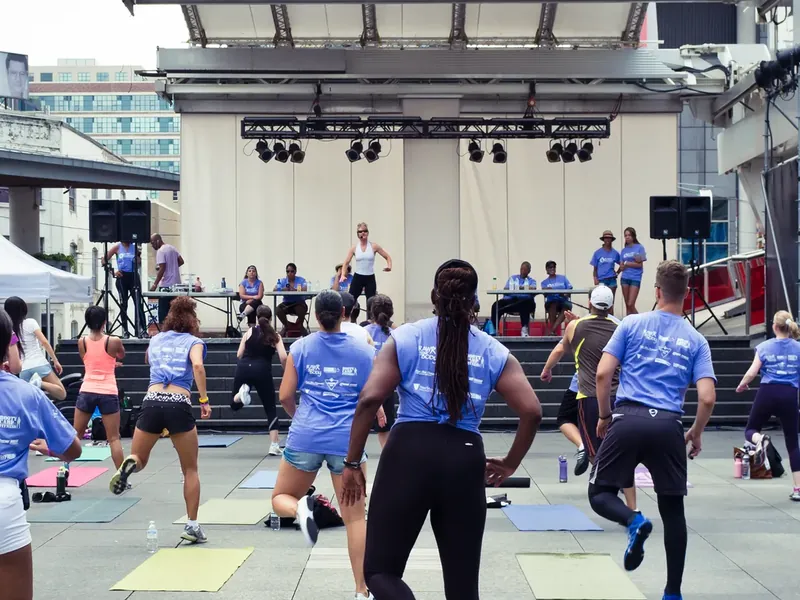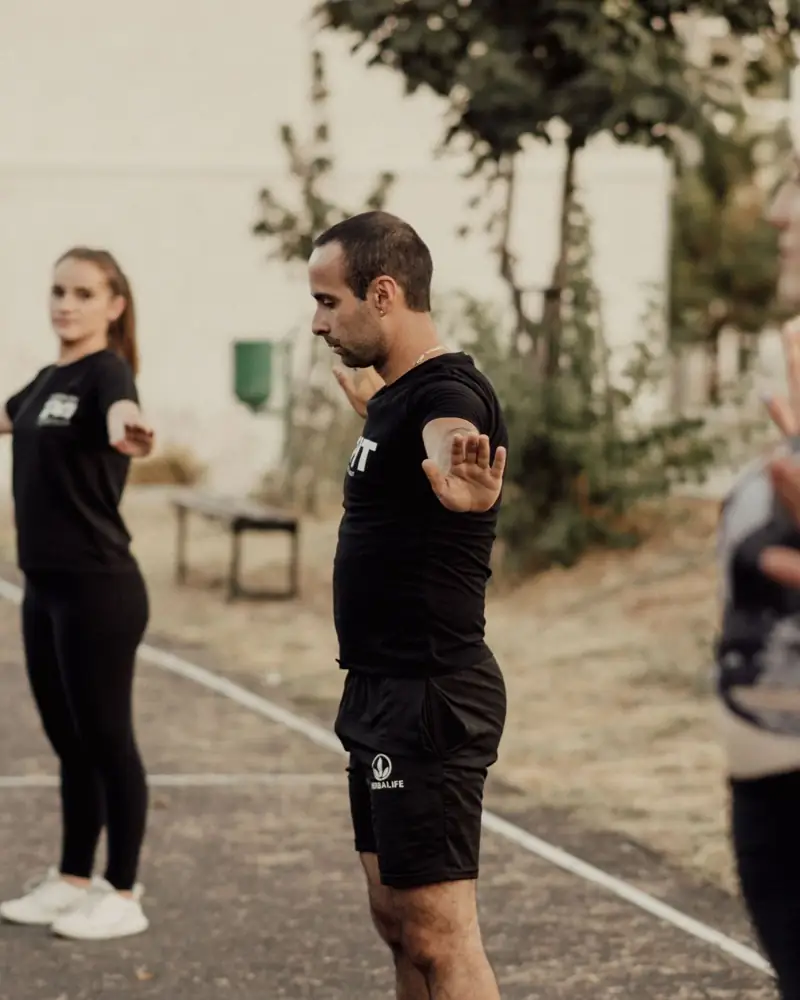
- A bootcamp workout is circuit training: strength and cardio moves done back to back in timed rounds, with short rests.
- Most sessions last 20 to 45 minutes, warm-up and cooldown included.
- The usual shape is 30 to 45 seconds of work, 15 to 30 seconds of rest, 5 to 8 exercises, repeated for 2 to 4 rounds.
- Intensity is set by three dials: which moves, how long you work, how long you rest. Beginners and experienced people can share one format.
- A floor is enough. Kettlebells, bands and a jump rope add options later.
The structure, specifically
Strip away the branding and a bootcamp session is circuit training: a set of exercises done one after another with minimal rest, then repeated for multiple rounds. A typical session mixes three ingredients in the same round: a strength move (squats, push-ups, lunges), a cardio burst (sprints, jumping jacks, mountain climbers), and something in between (burpees, kettlebell swings where equipment is available). Class-based bootcamps usually run 45 minutes; the self-led programs on this site run 20 to 45 depending on which one. None of it requires a gym: the at-home version runs the same format on a patch of floor, written out in a 15-minute and a 35-minute session.
Inside that session the order rarely changes. A warm-up of about five minutes comes first, then two or three working blocks, then a short finisher or a cooldown. A common block looks like this:
| Setting | Typical range | What it changes |
|---|---|---|
| Work interval | 30 to 45 seconds | Longer work shifts the load toward endurance |
| Rest between moves | 15 to 30 seconds | Shorter rest keeps the heart rate high between stations |
| Exercises per round | 5 to 8 | More stations spread fatigue across more muscle groups |
| Rounds | 2 to 4 | The simplest way to lengthen a session without new moves |
To make a round harder, cut the rest, add a weight to one or two moves, stretch the work interval, or swap in a jump or a sprint. To make it easier, do the reverse: rest longer, stay with bodyweight, shorten the work and pick the lower-impact version of each move. The circuit builder does this arithmetic for you from the minutes you have.
What a 45-minute class looks like
Studios vary, but a 45-minute class usually follows a clock close to this one:
| Minutes | Block | What happens |
|---|---|---|
| 0 to 7 | Warm-up | Joint circles, easy squats, marching or light jogging, a few ramp-up reps of the moves coming later |
| 7 to 20 | Block one | A lower-body and cardio circuit: squats, lunges, jumping jacks, high knees |
| 20 to 22 | Water | A proper break, the only one of the class |
| 22 to 35 | Block two | Upper body and core: push-ups, rows or band pulls, planks, mountain climbers |
| 35 to 40 | Finisher | One short all-out piece, often a timed set of burpees or a sprint relay |
| 40 to 45 | Cooldown | Walking, then static stretches for hips, hamstrings and chest |
A self-led session keeps the same order and simply trims the blocks. The warm-up and cooldown guide lists both ends move by move.
Your first class: what to expect
Your heart rate climbs within the first block and stays up, and most people are sweating before the warm-up ends. The pace feels fast because the moves change every 30 or 40 seconds, which also makes the time pass quicker than on a treadmill.
Nobody expects a first-timer to keep up with regulars. A good instructor demonstrates each move and calls out an easier version, and using it in the first weeks is normal. The people around you are busy with their own interval and are not watching your reps.
Bring water, a small towel and shoes with some lateral support, since you will jump, shuffle and lunge sideways. Eat something light an hour or two before. Tell the instructor about any injury before the class starts, not halfway through the second block. If a move hurts a joint, as opposed to making a muscle burn, stop and ask for a swap. The form mistakes guide covers the faults a timer tends to cause.
Common bootcamp exercises
Bootcamp borrows basic, full-body moves that need little equipment and are easy to scale. Most sessions pull from four groups:
| Group | Typical moves | What they train |
|---|---|---|
| Lower body | Squats, lunges in several directions, step-ups, glute bridges | Quads, glutes, hamstrings, calves |
| Upper body | Push-ups, rows, shoulder presses, band pull-aparts | Chest, back, shoulders, arms |
| Core | Planks, dead bugs, Russian twists, leg raises | Abs, obliques, lower back |
| Cardio | Jumping jacks, high knees, mountain climbers, burpees, short sprints | Heart rate and conditioning |
A balanced round takes at least one move from each group, so no single muscle group has to work two stations in a row. The full list with cues and an easier and harder version of each is in bootcamp exercises by category.
Equipment
Most bootcamp moves use body weight, which is why the format works in a park or a living room. Classes add dumbbells or kettlebells for squats, presses and swings, resistance bands for rows and pulls, jump ropes for short cardio bursts, and sometimes suspension straps or battle ropes. At home, buy nothing until the bodyweight versions feel manageable; the equipment guide lists what to add first and what to skip.
Benefits and limits
The main benefit is range. One session trains the legs, upper body and core and keeps the heart rate up the whole time, so the same 45 minutes covers conditioning and muscular endurance at once. The fixed format helps too: you turn up, follow the clock and finish, which makes it easier to keep going week after week than a plan you have to invent each time.
It has limits too. Bootcamp builds functional strength and endurance, but light loads and short rests are not the fastest route to bigger muscles or a heavier maximum lift. It will improve your running fitness without preparing you for a marathon. People training for a specific sport or a specific lift usually need programming built around that goal, with bootcamp as an extra session at most.
Bootcamp vs HIIT, circuit training and weight training
| Format | How it is built | Where it differs from bootcamp |
|---|---|---|
| Circuit training | Stations done in sequence with little rest | Same thing; bootcamp is the class name for it |
| HIIT | Near-maximal bursts with fixed short rests, often 20:10 or 2:1 | Stricter ratios and a harder effort, usually under 30 minutes |
| Steady cardio | One movement at a sustainable pace | No strength work and no change of movement |
| Weight training | Heavier loads, fewer reps, longer rest | Builds more maximal strength and muscle, less conditioning |
| CrossFit | Barbell lifts, gymnastics and cardio, tracked scores | More equipment and technique; see bootcamp vs CrossFit |
A bootcamp session often contains a HIIT block, which is why the two names get mixed up. The HIIT bootcamp on this site uses the strict 20:10 ratio for that reason.
Who it actually fits
New to training: bootcamp's biggest accessibility advantage is that most versions need no equipment and no complex technique, unlike barbell-based strength programs where poor form has real injury cost. Start with the beginner circuit and a slower work:rest ratio. The first four weeks are set out week by week.
Already training regularly: the same circuit format scales by raising work-interval intensity, shortening rest, or adding load, not by changing the structure. The HIIT program and the advanced progressions guide cover that end of it.
Short on time: a 30 to 45 minute session trains the whole body, which suits people who cannot fit separate cardio and strength days into a week.
Check with a clinician first if you have knee, hip or back pain, a heart condition, diabetes, or you are pregnant. Many standard moves are high impact. Most of them have a low-impact swap, but that choice belongs with someone who knows your history.
How it stacks up against national activity guidelines
The CDC's physical activity guidelines for adults call for 150 minutes of moderate-intensity activity a week, or 75 minutes of vigorous-intensity activity, plus muscle-strengthening work covering all major muscle groups on 2 or more days a week, at roughly 8 to 12 reps per exercise. A 45-minute bootcamp class run at genuinely hard effort counts as vigorous, so three sessions a week clears the vigorous-activity target on its own, and because the same round mixes squats, push-ups, and lunges, it covers the muscle-strengthening requirement in the same sitting instead of needing a separate lifting day.
Calorie burn scales with body weight and effort, not with the workout's name. Harvard Health's exercise-calorie tables list calisthenics, the bodyweight-move category bootcamp draws from, at 135 to 189 calories per 30 minutes at a moderate pace for a 125 to 185 lb person, and 240 to 336 calories per 30 minutes at a vigorous pace across that same weight range. A 45-minute class run near the vigorous end lands in roughly the 360 to 500 calorie band, before individual fitness level changes the number either way.
Frequently asked
How long is a typical bootcamp workout?
Most classes and self-led sessions run 20 to 45 minutes, warm-up and cooldown included. Shorter isn't automatically easier: a 20-minute HIIT-style bootcamp can be harder than a 45-minute low-intensity one.
Is bootcamp the same as circuit training?
Functionally, yes. Bootcamp is a marketing name for circuit training, exercises performed one after another with little rest, usually mixing strength and cardio moves in the same round.
Is bootcamp good for weight loss?
It can be part of one. The continuous, mixed-intensity structure burns more during the session than steady-state cardio at an easy pace, but weight loss still comes down to total calories in versus out over weeks, not any single workout.
How many times a week should you do bootcamp?
Three sessions a week with a rest day between suits most people. Beginners can start with two. A fourth session works once recovery keeps up, as long as the same muscle groups are not trained hard on two days running.
Does bootcamp build muscle?
It builds strength and muscular endurance, and beginners usually gain some muscle in the first months. For maximum size you need heavier loads and longer rests between sets than a circuit gives.
Do I need to be fit before my first class?
No. Classes are built to scale: take the easier version of each move, rest when you need to, and build up over the first few weeks.
What is the difference between bootcamp and HIIT?
HIIT is a way of timing effort: near-maximal bursts with fixed short rests. Bootcamp is a class format that often contains a HIIT block, plus strength stations and longer work intervals at a steadier effort.