Free / No account / Nothing to install
Bootcamp training
you can actually finish
Bodyweight circuits you can do in a front room or a park. Take one of the three ready sessions, or have the builder write one around the time you actually have.
Build me a sessionTake one of the three
- 3 ready programs
- Builder and timer
- A floor is enough
- Bodyweight squats30 s
- Push-ups30 s
- Reverse lunges30 s
- Plank hold30 s
- Glute bridges30 s
- Marching in place30 s
Get a session
Pick one of the three programs, or tell the builder your minutes, your level and what's in the room and let it write one.
Run it
One button opens the timer with the session loaded. It counts the intervals and names the station you're on, so nothing has to be memorised.
Repeat it for a month
Same session, three times a week, three to four weeks. That makes this week comparable to last week, the only way to see that anything is working.
01Programs
Three sessions, ready to run
Each has a warm-up, a timed exercise table, a cooldown and the reasoning behind the numbers. All programs
 Beginner
Beginner Bootcamp
A 20-minute bodyweight circuit built to be finished, not just attempted, with regressions for every move.
Open the program High intensity
HIIT Bootcamp
Real work:rest intervals, including the Tabata protocol, and how to tell if you're actually training at HIIT intensity.
Open the program Outdoor
Outdoor Bootcamp
A five-station park circuit, where the format actually comes from, and what to check before you start.
Open the program02Tools
Two tools that do the work
Both run in the browser, neither wants an account, and nothing you enter leaves your device. About the tools
Circuit builder
Give it your minutes, your level and what is in the room. It fills all six movement patterns and solves the rounds backwards from your time.
Build a sessionInterval timer
Runs 30/15, Tabata 20/10, 45/15 or anything you set, and names the station you are on and the one coming next.
Open the timer03Guides
The questions the programs raise
Form, recovery, equipment and what to do once bodyweight stops being hard. Every guide
Start here
DefinitionWhat is a bootcamp workout?
The direct answer: circuit-style training mixing cardio and bodyweight strength, plus who it actually fits.
Read the guideBeginnerBeginner bootcamp workout
The first four weeks, week by week: which regression to start from and when to drop it.
Read the guide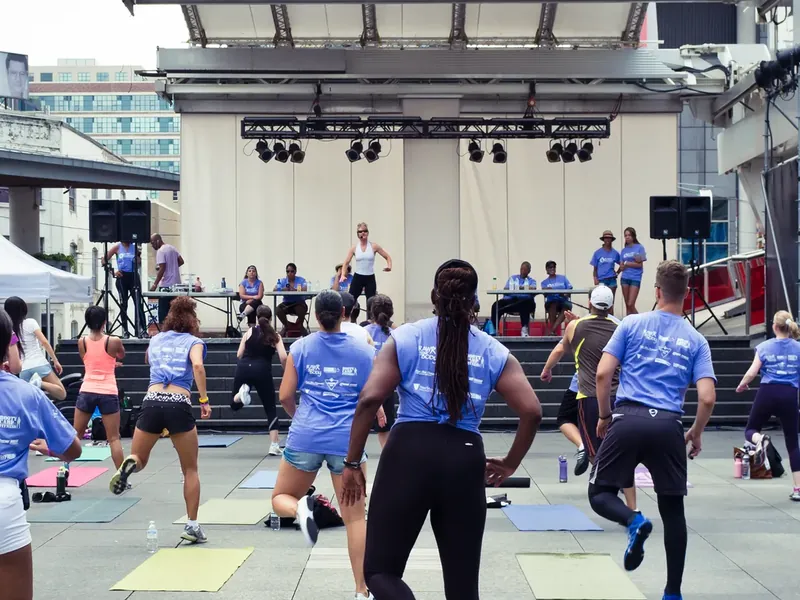 Technique
Form mistakes worth fixing
The dominant fault in squats, push-ups, lunges, planks, and burpees, and the fix for each.
Read the guideGoing further
ProgrammingBuild your own circuit
The six slots a circuit has to fill, how to pick the work:rest ratio, and the arithmetic for the session length.
Read the guide At home
Bootcamp workout at home
A six-move circuit needing only a floor and a wall, written out as a 15-minute and a 35-minute session.
Read the guide Advanced
Advanced bootcamp progressions
AMRAP, EMOM, and how to add load without losing the circuit format.
Read the guide04Program design
Built around three numbers
The same defaults run through every program and every guide on the site. How the programs are built
05FAQ
Common questions
Short answers. The guides have the long ones.
Do I need equipment for a bootcamp workout?
No. The beginner and most HIIT bootcamp formats are built around bodyweight moves: squats, push-ups, lunges, planks. Equipment like dumbbells or a jump rope adds variety later, it isn't a requirement to start.
How often should I do bootcamp workouts?
Three sessions a week with a rest or light-activity day between each is a common starting cadence. It's enough to build a habit and recover between sessions without burning out in the first two weeks.
Is bodyweight training enough to build strength?
For a beginner to intermediate level, yes. Bodyweight exercises can build real strength and conditioning; added resistance becomes more useful once bodyweight versions stop feeling challenging.